
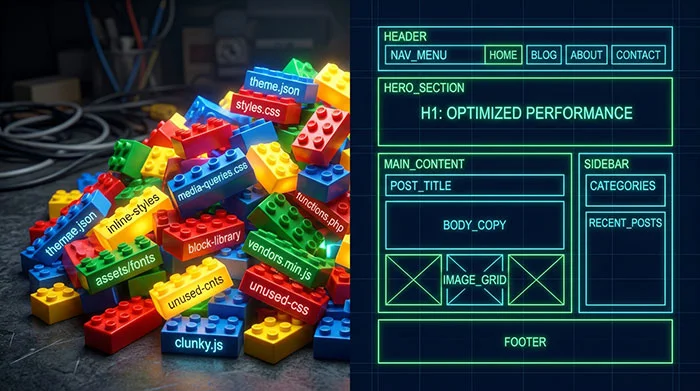
For the past few years, the core architectural vision pushed by WordPress leadership has felt like an evangelical crusade: convert every developer, designer, and agency to Full Site Editing (FSE). The promise was beautiful on paper—a utopian, unified ecosystem where everything from the header to the footer is a visual block, eliminating the line between the backend code and front-end design.
Fast forward to 2026, and the reality on the ground is starkly different. While automated onboarding wizards and casual hobbyist blogs have embraced native block themes, the high-end professional production environment has staged a quiet, ruthless mutiny. Step into any serious agency or talk to any enterprise frontend engineer, and you will hear a different story: FSE is not the future of professional development; it is an administrative and architectural choke point.
Instead of a grand migration, we are witnessing a deep ideological split. Here is an analytical look at why native block themes failed to conquer professional production, and why code-first alternative environments are winning the war.
1. The Core Misalignment: Designing for the Passenger, Not the Pilot
The foundational flaw of Full Site Editing lies in its target audience. FSE treats the website editing experience like an autonomous vehicle—designing a system so visual and enclosed that a literal passenger (the client) can steer it.
[ Traditional Paradigm ] ---> Developer Controls Layout PHP/CSS ---> Client Modifies Content
[ Native FSE Paradigm  ] ---> Block UI Exposes Layout Controls  ---> Client Accidentally Breaks Layout
But professional developers are pilots, not passengers. They need tight control panels, predictive instrumentation, and structural guardrails.
- The UI Overload: Gutenberg’s site-editing interface tries to be Figma, an IDE, and a content management system all at once. The result is a hyper-fragmented sidebar menu structure that requires dozens of clicks just to adjust deep-nested padding.
- The Client-Destruction Vector: In a professional production pipeline, you want to hand over a site that is bulletproof. FSE hands the client a loaded gun. Because layout structures, margins, and template loops are exposed directly in the block dashboard, an over-enthusiastic marketing manager can destroy an entire site’s visual grid system while attempting to fix a typo.
2. JSON Configurations vs. Dynamic PHP Logic: The Architectural Concrete
In traditional WordPress development, your theme is an organic organism powered by dynamic PHP templates, custom function hooks, and structured template hierarchies. If you need to inject complex conditional business logic—such as modifying layout execution based on specific database states or advanced user roles—you do it elegantly via code.
FSE attempts to abstract this architectural engineering into static theme.json files and specialized HTML block comments:
<!-- wp:group {"layout":{"type":"constrained"}} -->
<div class="wp-block-group">
    <!-- wp:post-title {"level":1} /-->
</div>
<!-- /wp:group -->
This structural shift transforms agile development into an exercise in fighting configuration constraints:
- Static Rigidity: Modifying styling frameworks globally through a massive, nested JSON manifest feels like building a ship inside a glass bottle. It replaces fluid programmatic expression with rigid, top-down configuration properties.
- The Broken Hook Ecosystem: Advanced modern styling workflows often rely on deep structural hooks (
add_action,do_action). FSE breaks this classic design pattern, forcing developers to look for messy JavaScript workarounds just to inject a tracking pixel or a custom dynamic element into a specific theme template node.
3. The Performance Mirage: DOM Bloat and Fragmented Assets
Core WordPress contributors heavily market block themes as the ultimate solution for speed and Core Web Vitals. Yet, when deployed in complex commercial contexts featuring deep-nested relational data, dynamic product loops, and multi-layered grid structures, the native block ecosystem reveals a massive performance hidden cost: DOM Bloat.
Because every layout block must wrap its contents in structural markup to support visual resizing engines in the admin backend, the rendered source code turns into an endless sea of nested <div> wrappers.
<!-- The Gutenberg "Div-Soup" Reality -->
<div class="wp-block-group">
    <div class="wp-block-group__inner-container">
        <div class="wp-block-columns">
            <div class="wp-block-column">
                <!-- Actual Content Is Buried Deep Down Here -->
            </div>
        </div>
    </div>
</div>
On heavy production pages, this deep DOM nesting causes significant performance penalties:
- Rendering Bottlenecks: Mobile CPUs struggle to calculate styles and paint the layout layout tree when the DOM depth surpasses modern architectural thresholds.
- Fragmented Critical Path: While Gutenberg tries to solve asset loading by breaking down stylesheets into component chunks, it frequently ends up scattering hundreds of unminified micro-inline styles across the header, triggering severe document rendering stalls.
4. The Rise of Alternative Paradigms: Why Bricks and Custom Engines Won 2026
Professional developers did not reject page builders because they hate visual interfaces; they rejected them when those interfaces produced slow, unmaintainable code.
When FSE forced a clunky block UI down developers’ throats, the production community pivoted to modern, high-performance compilation environments—most notably Bricks Builder and highly streamlined custom developer frameworks.
| Metric / Feature | Native FSE (Gutenberg Blocks) | Modern Code-First Builders (e.g., Bricks) |
| Class Management | Inline attribute objects or erratic global settings. | True BEM (Block, Element, Modifier) global style systems. |
| DOM Cleanliness | Deep “div-soup” structural wrappers. | Ultra-lean semantic markup with direct tag controls. |
| Developer Ergonomics | Constrained by theme.json schemas. | Direct integration with PHP classes, custom hooks, and clean CSS. |
| Data Architecture | Heavily married to post-content block blobs. | Seamless, granular binding with ACF and custom databases. |
By utilizing code-first builder platforms, developers get a visual preview workspace that honors clean frontend engineering rules. They can write pristine, semantic class structures, deploy highly integrated relational data schemes, and output a lightweight footprint that sails straight to a 100/100 Core Web Vitals score without fighting the core WordPress block editor engine.
Summary: A Pragmatic Verdict
Full Site Editing is an amazing tool for the end-user who wants to spin up a respectable portfolio page without touching a text editor. But as a production system for high-end, custom enterprise development, it is fundamentally a mismatch.
In 2026, professional developers have realized that separating layout engineering from content administration is not an outdated philosophy—it is an absolute operational requirement. By choosing code-first environments over native block layout bloat, engineers preserve their control over performance, security, and structural clean code.